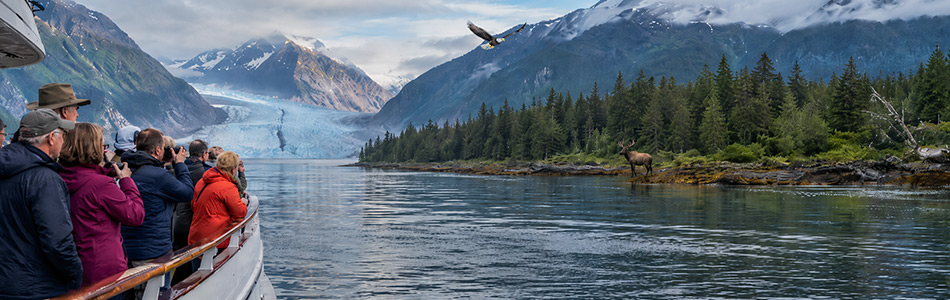
Experience Alaska's Wildlife on a Cruise

 Experience Alaska's Wildlife on a Cruise

On an Alaska wildlife cruise, travelers see humpback whales, orcas, brown and black bears, moose, bald eagles, sea otters, Dall sheep, and caribou in their natural habitats. Wildlife viewing peaks during the Alaska cruise season from May through September, when whales feed in coastal waters, bears gather near salmon streams, and migratory birds nest along cliffs and shorelines.

It's not surprising that in the land that has the biggest bears in the world, the largest salmon, the greatest gathering of bald eagles and more than half the world's humpback whale population, you'd find this kind of spectacular wilderness. View with your own eyes the most dramatic scenery and the most abundant marine life and wildlife in the world on your Alaska cruise.

Whales


Alaska's Whales

At a Glance:

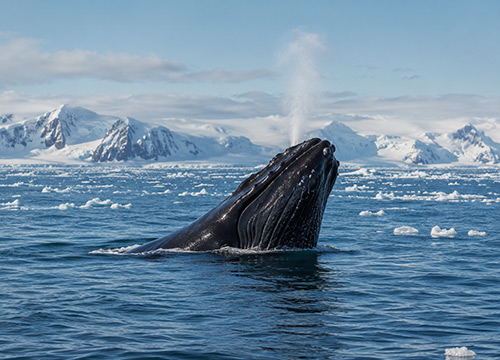
  • Species commonly seen: Humpback whales, orcas, and gray whales
  • Summer feeding season: May through September in Southeast and Southcentral Alaska
  • Migration: Humpback whales migrate from winter breeding grounds in Hawaii and Mexico
  • Average size: Adult humpback whales reach about 45 to 50 feet in length
  • Notable feeding behavior: Bubble net feeding documented in Southeast Alaska

For most, the concept of Alaskan wildlife doesn't extend beyond polar bears and salmon. But those who venture north know there's nothing like the sight of a 40-ton humpback whale breaking the surface of the water for air. During the summer months, more than 2,000 humpbacks are known to feed in the waters off Alaska, offering visitors plenty of chances to enjoy the splendor of these magnificent giants of the sea. Killer (orca) and beluga whales are equally abundant and bowhead whales, Alaska's state marine mammal, are found in the Arctic Ocean and northern Bering Sea.

Learn more about Alaska's whales and whale watching >

Bears


Alaska's Bears

At a Glance:

  • Species found in Alaska: Brown bears, black bears, and polar bears
  • Most commonly viewed in Southeast and coastal regions: Brown bears and black bears
  • Peak salmon activity: July through September near salmon streams
  • Habitat by species: Brown bears in coastal and interior regions, black bears in forested areas, polar bears in Arctic tundra and pack ice
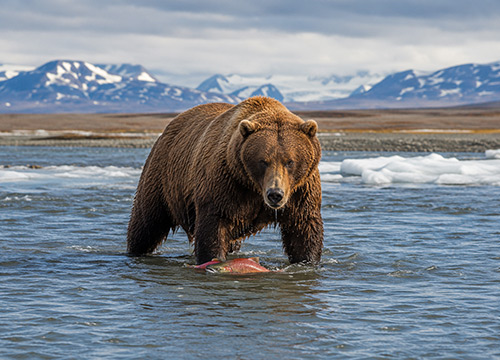
  • Notable behavior: Brown bears fish for salmon during summer runs

One of the things that makes Alaska so special is that all three species of North American bears flourish here. Brown/grizzly bears are found from the islands of southeastern Alaska to the arctic. Black bears inhabit most of Alaska's forests. Polar bears frequent the pack ice and tundra of extreme northern and western Alaska.

Bears are curious intelligent and potentially dangerous animals, but undue fear of bears can endanger both bears and people. Many bears are killed each year by people who are afraid of them. Respecting bears and learning proper behavior in their territory will help so that if you encounter a bear, neither of you will suffer needlessly from the experience.

Learn more about Alaska's bears and bear viewing >

Birds


Alaska's Birds

At a Glance:

  • Species diversity: More than 300 bird species are recorded in Alaska
  • Iconic species: Bald eagles, horned puffins, tufted puffins, and kittiwakes
  • Bald eagle population: Approximately 40,000 reside in Alaska
  • Nesting season: Late spring through summer along coastal cliffs and near rivers
  • Viewing context: Large seabird colonies nest along coastal cliffs, islands, and in Glacier Bay

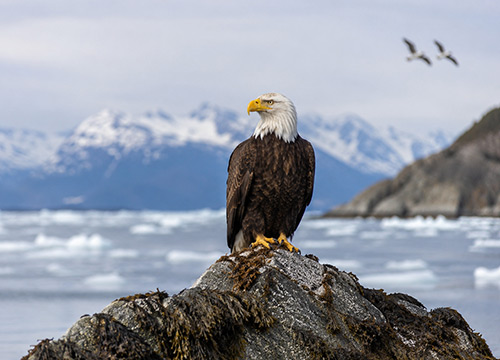
Flying high above it all is the majestic bald eagle, which boasts a wingspan of up to eight feet. Some 40,000 bald eagles reside in Alaska today, with most nesting near water for easy fishing. They are one of more than 300 species of birds that can be found here, each a delight to observe and photograph.

Other signature birds include the horned and tufted puffins, which thrive on the western end of Prince William Sound and along the Kenai Peninsula; the docile kittiwake, which nest in colonies along Glacier Bay; and the red-tailed hawk, a fixture at Wrangell-St. Elias.

Learn more about Alaska's birds and birdwatching >

Moose


Moose in Alaska

At a Glance:

  • Species: Alaska moose are the largest subspecies of moose in North America
  • Distribution: Found throughout much of the state except the far north and some islands
  • Typical size: Adult bulls can weigh up to 1,600 pounds
  • Calving season: Mid to late May
  • Habitat: Forested areas, wetlands, river valleys, and urban green spaces

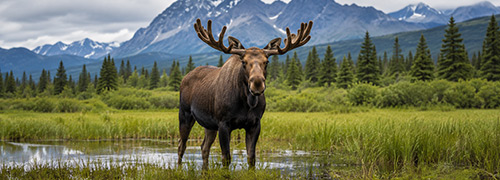
Moose - the largest deer species, - live almost everywhere in Alaska except on some islands and the far north. Anchorage, a city of 270,000, has hundreds of moose in the city limits, so don't be surprised to see a moose browsing in a park. Much of the Kenai Peninsula was set aside as a national wildlife refuge to protect the moose population from overhunting. They're also found frequently along highways and railroad tracks, browsing on willows or in small ponds.

As you drive at twilight, keep an eye on the sides of the road for horse-size animals that might walk in front of you. An adult male (bull) moose can weigh 1,600 pounds and the female (cow) a little less. Only the male has antlers, which fall off in the winter. Males can also be distinguised by their longer "bell" hanging from the lower jaw. Moose calves are born in mid-May. Whatever you do, don't get between a moose (cow) moose and her one or two calves; she will be protective. Even though moose seem cute, like Bullwinkle, they're wild animals and should not be fed or walked up to by well-meaning watchers.

Caribou


Caribou in Alaska

At a Glance:

  • Herds: More than 30 caribou herds range across mainland Alaska.
  • Best viewing areas: Denali National Park, the Denali Highway, the Dalton Highway, and the Arctic tundra regions.
  • Habitat: Tundra and taiga, including boreal forests near and above the tree line.
  • Size: Approximately 3 to 5 feet tall at the shoulder.
  • Weight: Males typically weigh 275 to 660 pounds; females 150 to 300 pounds.
  • Distinct trait: Both males and females grow antlers, unique among deer species.
  • Diet: Lichens, mosses, sedges, grasses, and woody plants.
  • Migration: Many herds migrate seasonally in response to food availability and weather conditions.

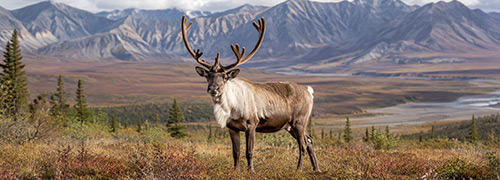
More than 30 herds of caribou are spread across mainland Alaska. Your best chance for seeing them are in Denali National Park and along the Denali Highway. Alaska Highway travelers may see caribou between Tok and Canada, and they're frequently found along the Dalton Highway, which stretches across the tundra of Arctic Alaska. Caribou live on the tundra and in the taiga, or short-tree forests. Caribou are medium-sized deer, 3 to 5 feet tall at the shoulder.

Males weigh 275 to 660 pounds, and females 150 to 300 pounds. Cows give birth to one or rarely two calves in spring or summer. Newborns weigh up to 13 pounds at birth. Woodland caribou have brown shaggy fur with a white neck, mane, belly, and tail, but caribou that live in Alaska and the arctic are almost completely white. Both male and female caribou grow antlers, which the caribou use for protection and to shove snow aside so the animals can reach the moss and lichen.

Caribou are the only deer species that lives above the tree line year-round in some of North America's harshest habitat. They live in Alaska, Canada, and parts of Washington, feeding on conifers, grasses, sedges, lichen, mushrooms, birches, and willows. However, since it is sometimes hard to find food in extreme cold, caribou populations migrate with the seasons.

Dall Sheep


Dall Sheep in Alaska

At a Glance:

  • Habitat: Open alpine ridges, meadows, and steep rocky slopes with nearby escape terrain.
  • Elevation range: Primarily high country above timberline, occasionally in rocky gorges below.
  • Best viewing areas: Denali National Park; Seward Highway at Windy Corner, Mile 106; Glenn Highway at Sheep Mountain, Mile 107.
  • Size: Rams up to about 300 pounds; ewes around 150 pounds.
  • Distinct feature: Rams develop curled horns that form a full curl by 7 to 8 years.
  • Diet: Grasses, sedges, and alpine vegetation; dried forage in winter, where wind exposes the ground.
  • Defense behavior: Use rugged escape terrain to evade predators.

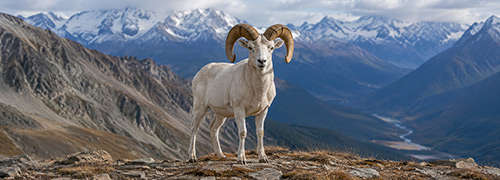
Dall sheep are found in relatively dry country and frequent a special combination of open alpine ridges, meadows, and steep slopes with extremely rugged "escape terrain" in the immediate vicinity. They use the ridges, meadows, and steep slopes for feeding and resting. When danger approaches they flee to the rocks and crags to elude pursuers. They are generally high country animals but sometimes occur in rocky gorges below timberline in Alaska. Look for Dall sheep at Denali National Park; along the Seward Highway at Windy Corner, Mile 106; and along the Glenn Highway at Sheep Mountain, Mile 107.

Dall sheep have curled horns and sleek legs, distinguishing them from the spiky horns and thick-haired legs of mountain goats. A Dall ram's horns grow into a half circle after two or three years and into a full circle, or curl, in seven or eight years. The nimble sheep grow to about 300 pounds for rams and 150 pound for ewes, feeding on a wide variety of plants. In the winter, they eat dried grass and sedge where the wind blows the snow off the ground.

Other Marine Life


Marine Life in Alaska

At a Glance:

  • Dolphins: Pacific white-sided dolphins are occasionally seen in coastal waters.
  • Seals and sea lions: Common along rocky shorelines and glacier ice.
  • Sea otters: Frequently observed floating on their backs in protected bays.
  • Salmon runs: Occur late spring through fall, drawing bears to rivers.
  • Best viewing areas: Prince William Sound and coastal fjords.

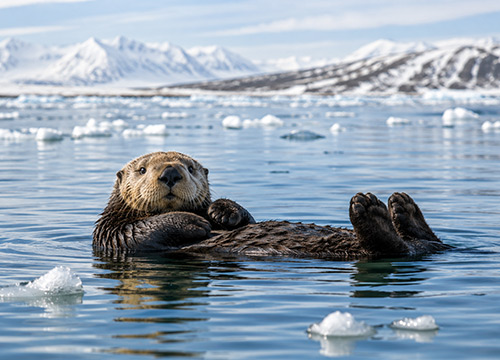
Sociable Pacific white-sided dolphins often entertain with their acrobatic leaps and somersaults. In Prince William Sound, seals and sea lions congregate along the shore and on chunks of glacier ice floating in the water. But the animal that seems to be enjoying itself the most is the irresistible sea otter, which often can be seen swimming on its back or hugging a friend as they frolic together in the water. Another active denizen of the sea is the salmon, famous for its gravity-defying leaps up waterfalls and streams in order to spawn. While this arduous trek only occurs at the end of an adult salmon's life, it never fails to coincide with feeding time for the brown bears that inhabit the Alaska coastline.

Learn more about marine life in Alaska >

Other Wildlife


Wildlife in Alaska

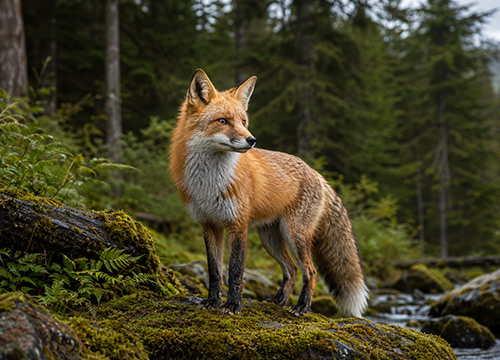
In Alaska, wilderness is king. You never know exactly what wildlife you're going to see. Besides whales, bears, birds, caribou, moose and the abundance of marine life, Alaska is also home to the grey wolf, red fox, musk oxen, mountain goats, lynx and much more. Only 90 miles of main road traverse the six million acres of Denali National Park, leaving the wildlife free to roam forests, tundra, glaciers, and mountains uninhibited.

On an Alaska cruise, wildlife can be seen along forested coastlines, remote inlets, and glacier-lined waterways. Sightings vary by region and season, so you can compare Alaska cruise options to find sailings that align with peak wildlife viewing.

Learn more about other wildlife in Alaska >

Best Time to See Wildlife on Your Alaska Cruise

Alaska cruises operate primarily from May through September, when many marine and land species are active along coastal routes and inland areas. Wildlife activity varies by region and annual conditions, but certain biological patterns, such as migration, nesting, and salmon runs, follow predictable seasonal timing. The table below reflects typical wildlife behavior during the Alaska cruise season.

Wildlife May June July August September
Humpback Whales Feeding in coastal waters after spring arrival Feeding in coastal waters Feeding in coastal waters Feeding in coastal waters Begin southbound migration
Orcas (Killer Whales) Present in coastal waters Present in coastal waters Present in coastal waters Present in coastal waters Present in coastal waters
Sea Otters Active in nearshore coastal habitats Active Active Active Active
Brown Bears (Coastal) Emerge from dens; feeding on vegetation and early food sources Salmon runs begin in some river systems Salmon feeding (varies by river) Salmon feeding continues Active prior to den entry
Moose Calving (mid-May to early June) Calving continues Summer feeding Summer feeding Rut begins
Caribou Spring migration; calving begins Calving period Summer grazing Fall migration begins Migration period
Bald Eagles Nesting Nesting and fledging Fledglings present Congregate near salmon runs Salmon feeding continues

Frequently Asked Questions

Are wildlife sightings guaranteed on an Alaska cruise?

No. Wildlife follows natural feeding and migration patterns, and sightings depend on location, weather, and timing. Cruise ships may slow or adjust course when marine wildlife is spotted, but viewing cannot be guaranteed.

Does cruise itinerary affect what wildlife you?re likely to see?

Yes. Cruises that travel through protected coastal waterways such as the Inside Passage emphasize marine wildlife, including whales and sea otters. Itineraries that include additional ports, glacier regions or land extensions may provide more opportunities to see land mammals such as bears or moose during excursions.

Can you see wildlife from the ship, or do you need excursions?

Many marine species, including humpback whales, orcas, and sea otters, are visible from the ship along coastal routes. Land mammals such as bears and moose are more commonly observed during shore excursions or in designated viewing areas.

Does weather affect wildlife viewing on an Alaska cruise?

Yes. Fog, heavy rain, and rough seas can reduce visibility, particularly for marine wildlife. Clear weather improves viewing conditions, although animal activity is not determined solely by weather.

Overlay Title